10 Story Starter Prompts to Beat Writer's Block
There's a specific kind of stuck I bet you know. You open the app, you know exactly what you want to feel — something quiet and a little sad, or sharp and funny — and then the cursor sits there because you don't have the first sentence. The mood is in your chest. The words aren't. That gap is where most reading nights die. These help once you're already moving; this pack is for the moment before movement, when you just need a door to walk through.
Why the first line is the hardest wall
I used to think the hard part was the middle — keeping a plot alive for three pages. It isn't. The middle is easy once something is happening. The wall is line one, because line one has to promise the whole book in ten words, and you're staring at a blank box with no permission to be bad yet. A starter prompt is that permission. It isn't the story. It's the hand on your back saying go.
The one rule that makes a starter feel like yours
Here's the trick I wish someone had told me: never paste a starter and stop. Change one word. If the line says funeral and your mood is actually a ruined birthday, swap it. The starter is a coat you try on, not a uniform. The moment you edit a noun, the voice becomes yours and the machine stops sounding like it's reading someone else's opener back to you. That single edit is the difference between borrowed and begun.
Ten story starter prompts, ten different moods
Narrative opener. The letter arrived three days after the funeral, and it was signed in a hand she'd sworn she'd never see again. Use this when you want to start inside a relationship that already has a past. The reader drops mid-current and has to swim. Add tone 'tender' and let it fill the gap.
Question opener. What if the people you pass every morning on the train are all running from the same secret? Questions pull the reader into a conspiracy on contact. I reach for this on restless nights — set pace 'brisk' and watch how fast the carriage turns into a plot.
Exclamation opener. God, how many times did I walk past that door before I noticed it was the only one with a light on? The energy of an exclamation sets a frantic, noticing tone. Great for urban or mystery moods where the narrator is half-delirious with curiosity.
Quote opener. 'A city is just a conversation that forgot to end,' my grandmother used to say — and that night, the city finally answered. A quoted line gives you a voice and a world-rule at once. Perfect for historical or literary-leaning chapters; keep stakes low and let the saying echo.
Scene-description opener. Rain had been falling on the tin roof for nine hours, and by the tenth the silence between them had grown teeth. Pure setting, no names, no event yet — just pressure building. This is my fallback when I want atmosphere before plot. Tone 'uneasy,' length 'short.'
Dialogue opener. 'You're late,' the stranger said, not unkindly, as if they'd been expecting each other for years. Dialogue opens mid-relationship and forces the model to invent the history. Use for romance or buddy stories; a bantering tone lands best.
Interior-monologue opener. I have counted the cracks in this ceiling so many times I've started naming them. A mind talking to itself is the fastest path to intimacy. First-person mode, 'aching' tone — this is the one I use when I actually miss someone and don't want to admit it.
Contrast opener. It was the happiest funeral anyone in the family could remember. A small contradiction makes the brain lean in. Ideal for dark comedy or wry family drama. Keep the ending dial on 'ambiguous' so the tension holds.
Temporal opener. By the third Tuesday of October, the lighthouse had stopped warning ships and started warning the town. Time as a character gives you a slow, eerie build. Horror or paranormal, pace 'slow,' and let the dread arrive implied, not shown.
Suspense opener. She kept the knife because the dreams had started coming in a language she almost understood. An image plus a half-secret. This is the opener I paste when I want the chapter to feel like it knows more than I do. Mystery or thriller, stakes 'high,' viewpoint 'close-third.'
How I actually use these on a bad night
Real example: last Tuesday I couldn't sleep and didn't want a book, I wanted a thing. I took the scene-description opener, changed 'tin roof' to 'radiator,' set tone 'uneasy,' and got a chapter about an apartment building where the heat never turns off and neither does the neighbor's crying. It wasn't good. It was exactly what I needed. That's the whole point of a starter — not perfection, a beginning.
And if you've felt the whole reading world leaning cozy this year, you're not imagining it. I broke down — and the opener types above are exactly the low-stakes, warm-start shapes that trend is built on.
Tweak it, don't trust it
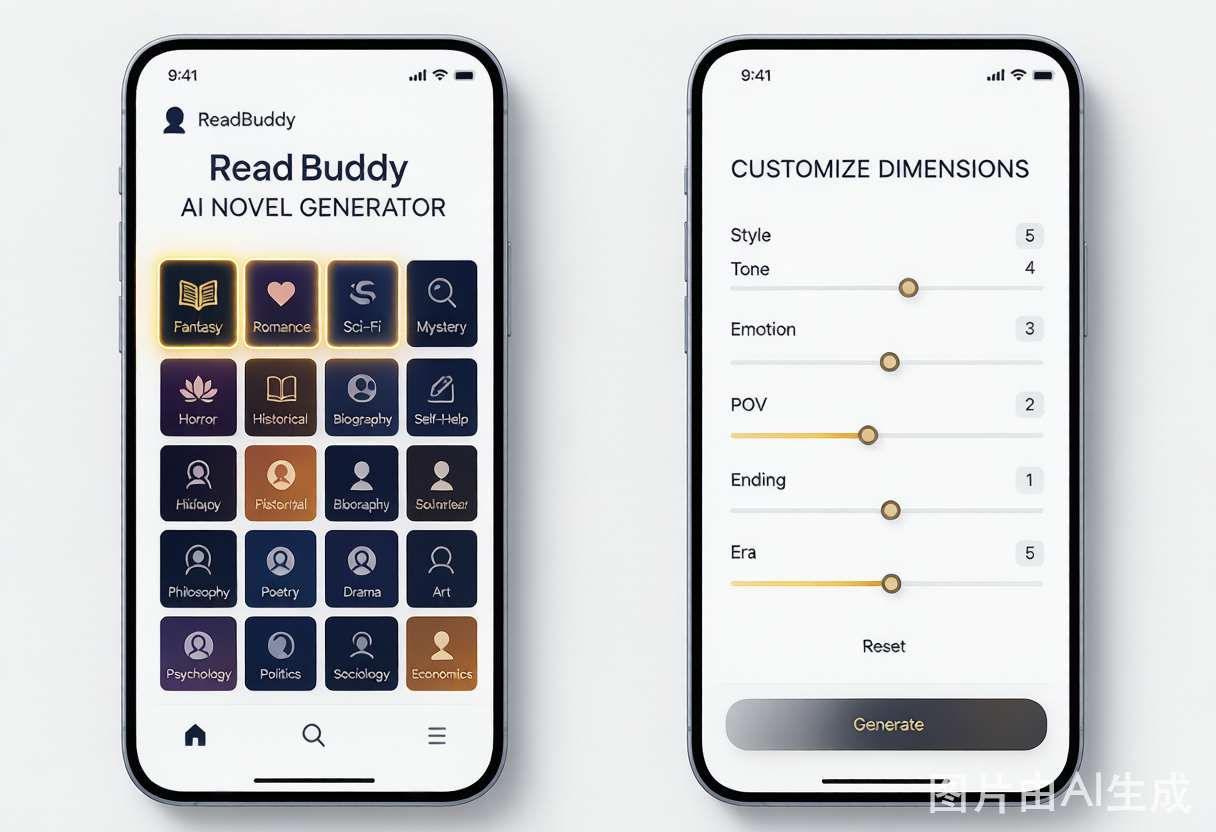
One last note. A starter prompt is a jumping-off point, not a spell. If the continuation feels off, the dials are the problem, not the line — the same way fall apart when you forget to name the voice first. Change one dial, regenerate, and the same opener becomes a different book. Keep this pack open next to ReadBuddy and the blank first line stops being a wall. It becomes an invitation.
Want a chapter written for your exact mood tonight?
ReadBuddy generates on the spot — 30 chapters free, no card. Android only (Google Play).
Get ReadBuddy