Write a Story for Your Mood Tonight with an AI Generator
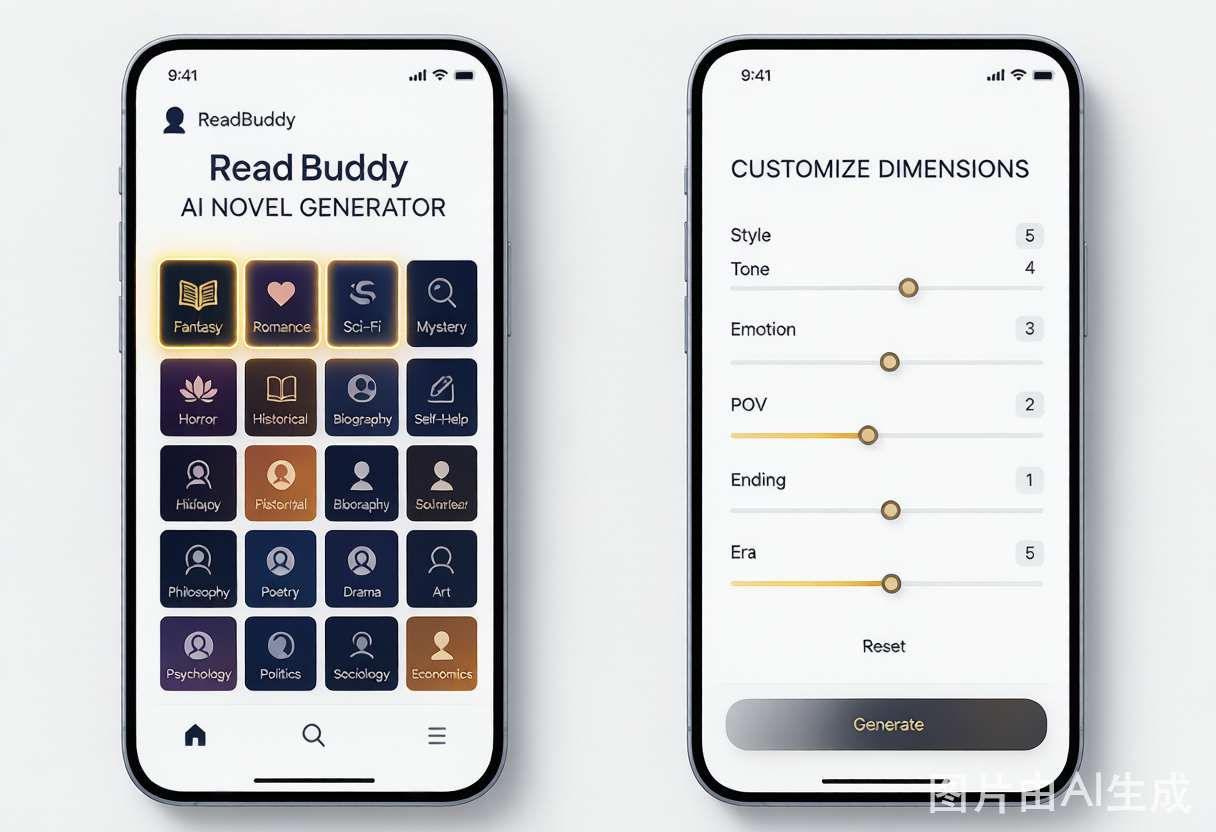
Open ReadBuddy and you'll see 14 genres and a handful of dials — tone, pace, stakes, viewpoint, length, ending. The mistake most new users make is leaving everything at default, then wondering why the chapter feels like it was written by a committee. Here's the flow that gets you something worth reading.
Why default settings read like a robot
When every dial sits in the middle, the model has no opinion to aim at, so it aims at 'average.' Average tone, average pace, average stakes. That's the uncanny valley of generated fiction: technically fine, emotionally absent. The fix isn't more settings — it's one specific feeling.
Step 1 — pick the genre that matches the feeling
Start with the emotion, not the shelf. If you're nostalgic, 'historical' or 'cozy' will serve you better than 'literary fiction.' If you want adrenaline without dread, 'thriller' beats 'horror.' The genre is just the costume the feeling wears — choose the feeling first, then the costume.
Step 2 — set tone to one specific word
This is the lever most people skip. 'Good' is not a tone. 'Wry,' 'tender,' 'tense,' 'bantering' — those are tones. One specific word tells the model exactly whose voice is speaking. I keep a short list pinned above my desk: wry, aching, brisk, warm, uneasy. Pick one before you touch anything else.
Step 3 — add one constraint
A constraint is a small rule the chapter must obey. 'Opens with dialogue.' 'No names in the first paragraph.' 'Set in a kitchen, not a battlefield.' Constraints are what separate a generated text from a generic one — they force a shape the model wouldn't choose on its own.
Step 4 — generate, then nudge one dial
Don't treat the first result as final. Generate once, read it, then change exactly one dial and generate again. Flip pace from steady to brisk. Drop stakes from high to low. The difference between a chapter you tolerate and one you bookmark is usually a single nudge, not a full rewrite.
The trick: name the night
Here's the thing that changed everything for me. A chapter written 'for a quiet Tuesday night when you miss someone' reads completely differently from one written 'for a rainy afternoon when you're restless.' Same tool, different soul. The constraint isn't about controlling the AI — it's about telling the truth about your own mood. Name the night and the words find you.
Three moods to try this week
If you're stuck, steal these: (1) 'a wry, low-stakes chapter for a Sunday when chores are the only plot.' (2) 'a tender opening line of dialogue between two old friends who lost touch.' (3) 'a brisk, uneasy scene for the 7pm train when you don't want to make eye contact.' Paste any into ReadBuddy and watch how fast it stops feeling like a machine.
If you'd rather skip the blank page entirely, I put together , lines you can paste straight into ReadBuddy tonight.
Comfort reading isn't a side quest — it's the breakout trend of 2026. I wrote up the data on , and it lines up exactly with what people generate here: warmth over adrenaline, every single time.
What not to do
Two traps I see constantly. One: stacking five constraints at once, which paralyzes the model into something safe and beige. Start with one. Two: regenerating the same prompt hoping it improves — if the first pass missed, the dials are the problem, not the luck. Change a dial, don't roll the dice again.
The multi-character version of this is where it gets fun — show how to keep several voices distinct instead of blending them together. And if you ever wonder why we built generation instead of a book list, explains the six weeks I would rather forget.
Want a chapter written for your exact mood tonight?
ReadBuddy generates on the spot — 30 chapters free, no card. Android only (Google Play).
Get ReadBuddy